Table Of Content

I'm telling you they came out of those cars — and we have enough witnesses to hang them — with their guns smoking. Chief Parker knows this, Mayor Yorty knows this and every police official in the city knows that. They fired warning shots point-blank at innocent, unarmed defenseless Negroes. Another was shot— two of them were shot — excuse the expression — through the penis. There was s time when we used to drool in the mouth over white people.
Post-Sanford and Son
Malcolm's Ministry Brandon M. Terry - The New York Review of Books
Malcolm's Ministry Brandon M. Terry.
Posted: Thu, 25 Feb 2021 08:00:00 GMT [source]
He first rose to prominence in the late 1940s, as a member of the Nation of Islam, a religious organization that mixes elements of traditional Islam and Black nationalism. His iconic status, if not solidified during his lifetime, was certainly achieved shortly after his death with the publication of the acclaimed The Autobiography of Malcolm X. The famed British Prime Minister was nicknamed “copper knob” while attending school at Harrow due to his red hair. Churchill’s talent for eloquent and impassioned speeches and his ability to rally members of the public to a common cause proved indispensable to Great Britain during World War II. It’s no secret that redheads are rare—between 1 and 2 percent of the world’s population has natural red hair. Yet despite the fact that they are a genetic minority, redheads have tended to make waves in history.
Early years
On February 25, 1964, the boxer known as Cassius Clay bested Sonny Liston to become world heavyweight champion. The next day, he proclaimed at a press conference he’d be henceforth known as Cassius X, and a few months later, he changed his name to Muhammad Ali. This was the coming out of a spiritual change that had already taken place, guided by Malcolm after the two met in 1962 and cultivated a friendship. Ali was impressed by Malcolm’s speech at a NOI event and the latter became a mentor for the up-and-coming fighter.
Metallic Red Hair Color
When work spread that Hinton was dying, Malcolm ordered the Muslims into the streets. After his release from prison Malcolm helped to lead the Nation of Islam during the period of its greatest growth and influence. He met Elijah Muhammad in Chicago in 1952 and then began organizing temples for the Nation in New York, Philadelphia, and Boston and in cities in the South. He also articulated the Nation’s racial doctrines on the inherent evil of whites and the natural superiority of Blacks. Malcolm excelled in school, but after one of his eighth-grade teachers told him that he should become a carpenter instead of a lawyer, he lost interest and soon ended his formal education.

Malcolm X converted to the Nation Of Islam while he was in jail.
Explore the nuanced narrative of Malcolm X’s red hair, delving into its historical context and symbolic significance, offering a profound glimpse into the intricate facets of his life. During his youth, the eminent African-American leader Malcolm X sported distinctive red hair, earning himself the moniker Detroit Red. This unique characteristic, a reddish tint to his hair, finds its historical roots in his white Scottish maternal grandfather, who entered into a troubled union with Malcolm X’s maternal grandmother. Let’s explore the enigma of the Malcolm X red hair as we delve into the historical context and symbolic significance surrounding this remarkable feature.
Personal life
Though highly intelligent and a good student, he dropped out of school following eighth grade. He began wearing zoot suits, dealing drugs and earned the nickname “Detroit Red.” At 21, he went to prison for larceny. The Malcolm X red hair, while not the norm within the Afro-American community, is not necessarily viewed as an anomaly. Instead, it serves as a celebration of the diversity inherent in Afro-American identity. Malcolm X’s unique physical feature symbolizes the community’s vast heritage, reflecting the varied origins contributing to the mosaic of Afro-American culture. The significance of the Malcolm X red hair extends beyond mere aesthetics.
The iconic figures in 'One Night in Miami' - DW (English)
The iconic figures in 'One Night in Miami'.
Posted: Fri, 15 Jan 2021 08:00:00 GMT [source]
The purpose of making that statement was to fortify the Muslims, so I wanted to talk to the Muslim for the point— and that's why I was brought to Chicago — to make a statement that would strengthen the Muslims. So I went forth to talk about Islam and how it is— my regular teaching. But when I got ready to make my statement, John Ali put a paper in front of me and told me I should read that, that it had been prepared for me to make. And if Jesus were here in America today, he wouldn't be going to the white man. One of the world’s most famous artists known for his vibrant paintings, Van Gogh sported equally vibrant red hair, which took on a particularly fiery hue in his beard.
The FBI created a file for Malcolm X after he wrote to President Truman.
Public interest in this unique physical trait reflects a collective fascination with the individual nuances that contribute to the enigmatic persona of Malcolm X. Although there isn’t extensive documentation of Malcolm X explicitly reflecting on his red hair, his speeches and writings occasionally reference it. These references, often brief, add a layer of intrigue to the enigmatic personality of Malcolm X. Delving into Malcolm X’s ancestry may provide insights into the potential roots of his red hair. Familial genetic variations and historical connections to regions with higher occurrences of red hair can shed light on the origins of this distinctive trait within his family tree.
1947Malcolm meets a fellow convict he calls "Bimbi," who convinces Malcolm to study and learn to develop his mind. In Jarvis' words, in prison "the only way we knew how to rebel was to cram some knowledge into our brains." The ever-scheming European imperialists wisely placed Israel where she could geographically divide the Arab world, infiltrate and sow the seed of dissension among African leaders and also divide the Africans against the Asians. Between Mr. Muhammad's teachings, my correspondence, my visitors ... And my reading of books, months passed without my even thinking about being imprisoned.
While in prison for robbery from 1946 to 1952, he underwent a conversion that eventually led him to join the Nation of Islam, an African American movement that combined elements of Islam with Black nationalism. His decision to join the Nation also was influenced by discussions with his brother Reginald, who had become a member in Detroit and who was incarcerated with Malcolm in the Norfolk Prison Colony in Massachusetts in 1948. Malcolm quit smoking and gambling and refused to eat pork in keeping with the Nation’s dietary restrictions. In order to educate himself, he spent long hours reading books in the prison library, even memorizing a dictionary. He also sharpened his forensic skills by participating in debate classes.
At a time when black civil rights leaders preached harmony and integration, Malcolm preached a militant gospel of self-defense and nationalism that terrified many whites and disturbed, yet also inspired, black Americans. After his travels to Africa and Mecca, he returned with a deeper understanding of Islam and a new willingness to accept white allies. "The white man and the black man have to be able to sit down at the same table," he said in his last year. "Then they can bring the issues that are under the rug out on top of the table and take an intelligent approach to getting the problem solved."
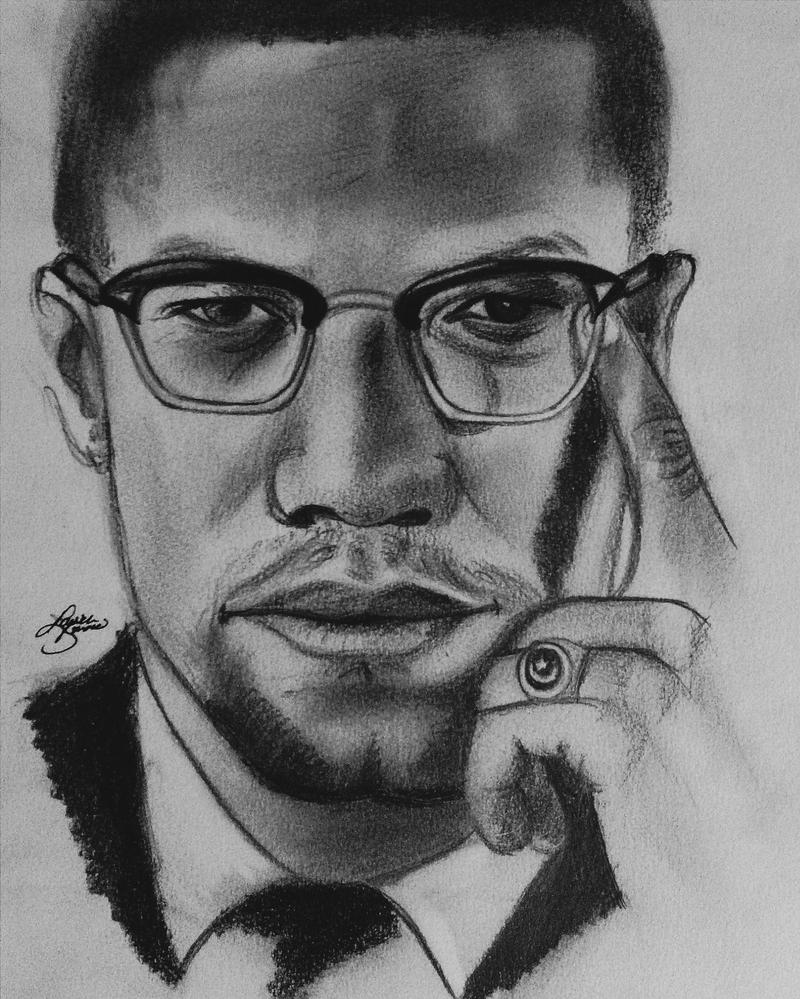
Born in Nebraska, while an infant Malcolm moved with his family to Lansing, Michigan. The surviving family was so poor that Malcolm’s mother, Louise Little, resorted to cooking dandelion greens from the street to feed her children. After she was committed to an insane asylum in 1939, Malcolm and his siblings were sent to foster homes or to live with family members.
It was in jail that Malcolm X first encountered the teachings of Elijah Muhammad, head of the Lost-Found Nation of Islam, or Black Muslims, a Black nationalist group that identified white people as the devil. Soon after, Malcolm adopted the last name “X” to represent his rejection of his “slave” name. Malcolm X’s red hair has indelibly impacted public fascination and discourse. Its impact lies in its ability to transcend time, remaining a topic of discussion and contemplation. The ongoing interest serves as a testament to the enduring legacy of Malcolm X and the multifaceted layers that contribute to his iconic status. Anecdotal insights from Malcolm X himself regarding his red hair remain elusive.
He also renounced his previously held separatist views after converting to orthodox Islam, and he expressed a desire near the end of his life to work more closely with the civil rights movement. Before Malcolm became a national civil rights speaker and John Sanford became a nationally beloved comedian, they were known respectively as Detroit Red and Chicago Red because of their red hair. In 1943, they worked as dishwashers at Jimmy’s Chicken Shack in Harlem and committed petty crimes together. Sanford, whose stage name was Redd Foxx, went on to become one of the first Black performers to play to white audiences in Las Vegas, put out several hit comedy albums, and become an icon, starring in the 1970s sitcom Sanford and Son. At age 6, the future Malcolm X entered a foster home and his mother suffered a nervous breakdown.
Malcolm X had predicted that he would be more important in death than in life, and had even foreshadowed his early demise in his book, The Autobiography of Malcolm X. Malcolm X is buried in Ferncliff Cemetery, New York. His advocacy of achieving “by any means necessary” put him at the opposite end of the spectrum from Martin Luther King, Jr.’s nonviolent approach to gaining ground in the growing civil rights movement. In 1931, Malcolm’s father was allegedly murdered by a white supremacist group called the Black Legionaries, though the authorities claimed his death was an accident. Mrs. Little and her children were denied her husband’s death benefits. Malcolm X’s red hair is often portrayed as a symbol of individuality and diversity in literature and art, contributing to the nuanced representation of his legacy. The enduring curiosity surrounding Malcolm X red hair remains a captivating aspect of his legacy.


No comments:
Post a Comment